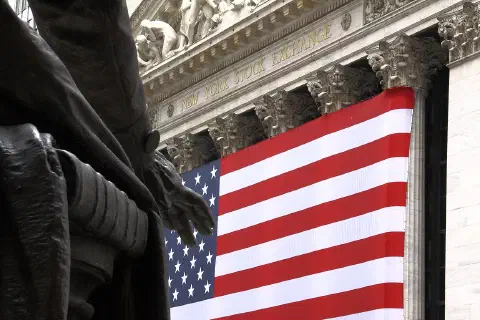
Buffett is sitting on $277bn of cash

Berkshire Hathaway's second-quarter filings sent markets a clear message about valuations. Warren Buffett's conglomerate held a record $276.9 billion in cash and Treasury bills, after selling nearly half of its large stake in Apple. The Oracle of Omaha has built himself a fortress of government paper.
The Apple sales were the headline. Berkshire had already trimmed the holding in the first quarter, and at the annual meeting in May, his first without his long-time partner Charlie Munger, who died last November, Mr Buffett hinted that the prospect of higher capital-gains taxes was one reason to take profits now. The second-quarter filings showed the selling had gone much further. Berkshire has also been selling shares in Bank of America, another of its biggest holdings, since the middle of July.
Bills beat stocks, for now
Buffett's selling and hoarding reflect a cold reading of risk and reward, and make no forecast about the economy. When Treasury bills pay over five per cent and share prices sit near historic valuation extremes, holding cash is an active choice that earns a decent return. Buffett is getting ready, without fuss, for the market trouble he evidently expects sooner or later.
The arithmetic is simple. At five per cent, a pile of $276.9 billion earns roughly $14 billion a year with no credit risk and no exposure to a falling market. For a share to be more attractive, its expected return has to beat that comfortably after allowing for the chance of losses. When the S&P 500 trades near the top of its historical valuation range, the earnings yield on the market as a whole is not much higher than what bills pay, and the extra reward for owning equities has shrunk to very little.
The company's own shares tell the same story. Berkshire bought back none of its stock in the second quarter, although Mr Buffett has long said he will repurchase shares whenever they trade below his estimate of their intrinsic value. If he does not think his own company is cheap enough to buy, it is hard to argue that he sees bargains elsewhere in the market.
A habit of waiting
Mr Buffett has done this before. In 1969 he closed his investment partnership, telling his partners that he could no longer find enough bargains in a frothy market, and the early 1970s duly brought a bear market. During the technology boom of the late 1990s he kept away from internet stocks and was mocked for it, until the bubble burst. The reward for patience came in 2008, when Berkshire used its cash to buy preferred shares on generous terms in Goldman Sachs and General Electric as markets seized up.
The lesson Mr Buffett draws from those episodes is that cash is most valuable when others are forced to sell. A fortress of Treasury bills lets Berkshire act as a lender or buyer of last resort in a crisis, on terms that ordinary investors cannot match. The cost is years of lagging a rising market while waiting.
The case against reading too much into it
There are reasons not to treat the pile as a precise market call. Berkshire has carried well over $100 billion of cash for years, through a long bull market, because it is now so large that few acquisitions can move its earnings. Mr Buffett likes to buy whole companies, and there are only so many businesses big enough to matter to a firm of Berkshire's size and cheap enough to satisfy him. The cash pile partly reflects that shortage of elephants, as he has put it, rather than a forecast of doom.
The tax motive also muddies the signal. Berkshire bought most of its Apple shares cheaply years ago, so every sale realises a large gain. If Mr Buffett expects tax rates to rise under a future government, selling now is a tax decision as much as a valuation one. And Apple remains Berkshire's largest holding even after the sales, which hardly suggests a loss of faith in the company.
Who should take note
Even with those caveats, the combination matters. Berkshire has been a net seller of shares for several quarters and has made no large acquisition since buying the insurer Alleghany in 2022. Mr Buffett, at 93, has named Greg Abel as his successor, and he may be leaving a balance sheet designed to give the next generation of managers room to act in a downturn. For investors who have ridden the rally in large technology stocks, the message is that one of the most successful investors alive sees better value in a Treasury bill than in the market's favourite company.
What would change the stance
Two things could draw the cash back into shares. The first is a sharp fall in stock prices, which would restore the margin of safety that Mr Buffett demands. The second is lower interest rates, which would cut the return on bills and make equities relatively more attractive. The Federal Reserve is expected to start cutting in September, so the second may arrive first. Berkshire's third-quarter filings in November, and its list of holdings published shortly afterwards, will show whether the selling has continued.
Buffett's $277 billion cash pile says share prices are too high to be worth the risk while bills pay this well. He will probably keep adding to it until stocks get cheaper or yields fall. Expect Berkshire to stay a net seller through the rest of this year, with the money going back into shares only if a sell-off offers bargains, and with investors crowded into the biggest technology names the most exposed if he turns out to be right.
Write to Arnav Goel at contact@thelombardreview.com
The Sunday Edition, in your inbox
India's economy, markets and money every Sunday, plus our analysis twice a week. Free.
Unsubscribe any time. See our Privacy Notice.