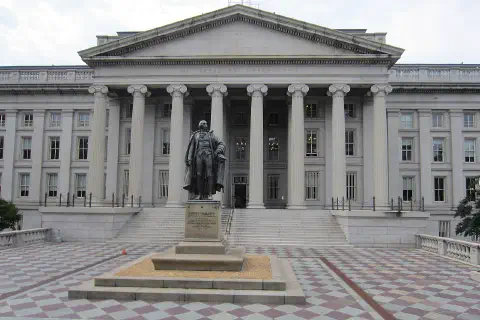
Election night for the bond market

The ten-year Treasury yield jumped sixteen basis points to 4.44 per cent overnight as returns confirmed Donald Trump's clear victory and a Republican sweep of Congress. That leaves it 80 basis points above where it stood when the Fed cut rates in September. Bond traders did not wait for the concession speech.
Other markets moved in step. The dollar rallied against almost every major currency, with the Mexican peso and the euro among the hardest hit, and futures on American stock indices pointed sharply higher. Bitcoin set a record. The pattern was consistent across assets: investors expect faster growth and higher inflation in America, larger deficits to finance, and a Fed that will have less room to cut.
A red wave hits Treasuries
With one party controlling both the White House and Congress, gridlock goes. That clears the way for a full extension of the 2017 Tax Cuts and Jobs Act, broad tariffs on imports and a push to deregulate. Bond desks moved at once to price in faster growth and stickier inflation, along with much heavier federal borrowing. Investors want a higher term premium to hold long-dated debt against that prospect.
The arithmetic of the deficit
The starting point is already uncomfortable. The federal government ran a deficit of about $1.8 trillion in the fiscal year that ended in September, a level normally seen only in recessions or wars, and debt held by the public is close to the size of the whole economy. Most of the individual tax cuts from 2017 are due to expire at the end of next year. The Congressional Budget Office has estimated that extending them would add more than $4 trillion to deficits over a decade, before counting the new tax breaks promised during the campaign.
Tariffs cut the other way on paper, since duties on imports raise revenue. The campaign proposed a universal tariff of 10 to 20 per cent and a rate of 60 per cent on Chinese goods. Even if those plans were enacted in full, the revenue would be offset in part by slower trade and by any retaliation. The same tariffs would push up the prices of imported goods, which is the inflation half of the bond market's worry.
How the move works
Higher long yields reflect three separate forces. The first is the expected path of the Fed's policy rate: if growth and inflation run hotter, investors expect fewer rate cuts next year. The second is inflation compensation, the extra yield demanded to protect against rising prices. The third is the term premium, the reward for tying up money for ten years when the supply of such debt is set to grow. Election night pushed all three up at once, which is why the move was so large.
The supply channel is the one that lingers. Every dollar of extra deficit has to be financed by selling Treasuries, and the Fed is still shrinking its balance sheet, so private buyers must absorb all of it. Foreign central banks have been buying proportionately less for years. Domestic investors are willing buyers, but only at a price, and that price is a higher yield.

Echoes of 2016
The closest precedent is Trump's first victory. After the election in November 2016, the ten-year yield rose by more than half a percentage point in the following five weeks as investors priced in tax cuts and infrastructure spending. That move was eventually confirmed by the tax bill a year later. The difference now is the starting point: in 2016 yields were near historic lows, inflation was below target and the deficit was far smaller. Today the market is being asked to finance a fiscal expansion from a much weaker position.
A second, cautionary precedent comes from Britain. In September 2022 Liz Truss's government announced large unfunded tax cuts, and gilt yields rose so fast that the Bank of England had to intervene to protect pension funds. The Treasury market is deeper and the dollar's reserve role gives America more latitude than Britain had. The episode still shows how quickly bond investors can force a government to change course when they doubt its sums.
Who pays
The first losers are borrowers. Mortgage rates in America track the ten-year yield, and they are already back close to 7 per cent despite the Fed's cuts, which will keep the housing market frozen for longer. Companies that need to refinance debt face higher coupons, and so does the Treasury itself, whose interest bill already exceeds its spending on defence. Emerging markets suffer through the dollar: a stronger currency and higher American yields pull capital home and raise the cost of servicing dollar debts abroad.
Savers and banks gain. Retirees and insurers can lock in higher yields for longer, and lenders earn more when long rates rise faster than short ones. Holders of dollars gain against most other currencies, which is cold comfort for exporters in Europe and Asia facing the threat of tariffs at the same time.
The case against
Bond bulls have arguments. Campaign promises are usually diluted in legislation, and the Republican majority in the House is likely to be narrow enough for deficit hawks to extract concessions. The campaign has also floated a government efficiency commission, involving Elon Musk, to cut federal spending, and lighter bank regulation could make it cheaper for lenders to hold Treasuries. If tariffs slow growth more than they raise prices, yields could fall back. These are real offsets, though each depends on decisions that have not yet been made, while the tax extension looks close to certain.
What to watch
The Fed meets on Thursday and is expected to cut by a quarter-point. The chair's comments on how the central bank will treat the new administration's fiscal and trade policies will matter more than the cut itself. After that, the key signals are the Treasury's quarterly announcements of auction sizes, the choice of Treasury secretary, and the first outline of a budget reconciliation bill once the new Congress sits in January.
The bond market has read the Republican sweep as a mandate for more inflation and more Treasury supply. Long yields will probably stay high until the new administration shows how it intends to pay for its plans. Without credible offsets, the ten-year yield is more likely to test 4.75 per cent in the coming months than to fall back towards 4 per cent.
Write to Arnav Goel at contact@thelombardreview.com
The Sunday Edition, in your inbox
India's economy, markets and money every Sunday, plus our analysis twice a week. Free.
Unsubscribe any time. See our Privacy Notice.