Gold breaks $3,700

Spot gold broke through $3,700 an ounce and was trading near $3,750, one of the fastest bullion rallies in modern financial history. The price no longer tracks the usual models built on American real interest rates and the strength of the dollar.
The milestones have come quickly. Gold crossed $3,000 for the first time in March, briefly touched $3,500 in April during the turmoil that followed the tariff announcements, and after a summer of consolidation has pushed higher again since late August. It is up by more than a third since the start of the year, a pace more typical of a speculative share than of the oldest reserve asset there is.
Real yields stop mattering
Gold used to move against US real yields. When inflation-adjusted Treasury yields rose, holding a metal that pays nothing became expensive. That link has broken. The rally is being driven by steady buying from foreign central banks and reserve managers across the Global South, who pay little attention to price. They are moving reserves away from the dollar now that Washington uses tariffs and asset sanctions as weapons.
The break is visible in the numbers. Real yields on ten-year inflation-protected Treasuries remain far above the negative levels of 2020 and 2021, yet gold has roughly doubled from its level then. Under the old relationship a real yield this high would have capped the price well below today's level. The Fed's rate cut last week helps at the margin, but the rally began long before markets expected easing.
The weaponised dollar
The turning point came in February 2022. After Russia invaded Ukraine, Western governments froze roughly $300 billion of the Russian central bank's reserves held in their jurisdictions. Reserve managers elsewhere drew the obvious conclusion: securities held abroad in dollars, euros or sterling are safe only as long as the holder stays on good political terms with the issuers.
Central banks have bought more than 1,000 tonnes of gold in each of the past three years, roughly double the typical annual pace of the previous decade. China's central bank has reported additions to its reserves month after month since late last year, and Poland's has been among the largest buyers in the world. The European Central Bank reported in June that gold had overtaken the euro to become the second-largest reserve asset held by central banks, measured at market prices, behind only the dollar.
The shift is gradual rather than dramatic. The dollar's share of the world's official foreign-exchange reserves, as reported to the International Monetary Fund, has drifted down over two decades to below 60 per cent, and much of what it lost went to smaller currencies such as the Canadian and Australian dollars rather than to the renminbi. Gold is outside those figures altogether, which is why its rising share shows up in the price rather than in the currency statistics.
Safe from sanctions
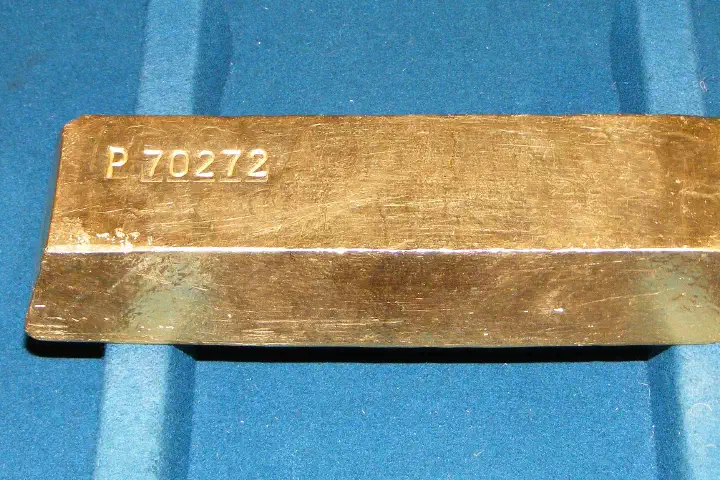
For a finance ministry, gold kept in its own vaults is the one asset with no counterparty and nothing a foreign government can freeze. No Western executive order can reach it. Retail speculators have little to do with the price.
This year has added new motives. Tariffs imposed under emergency powers have shown that access to the American market can change by executive order, and the White House's attempt to remove a Fed governor has raised questions about the independence of the institution behind the dollar. A reserve manager worried about either risk can diversify into other currencies, but none offers the depth of the Treasury market. Gold is the only large alternative that belongs to no government.
Western investors have returned to the market this year through exchange-traded funds, after years of net outflows. That flow amplifies moves but does not explain the trend. Fund holders sell when prices fall or real yields rise; central banks buying for strategic reasons tend to add on dips, which is why each correction in the past three years has been short.
Lessons from 1980 and 2011
Gold has had parabolic rallies before, and both ended badly. After Richard Nixon closed the gold window in 1971, the price rose through a decade of inflation to peak at $850 an ounce in January 1980; when Paul Volcker pushed real interest rates sharply higher, it fell and took two decades to recover. In 2011 gold climbed above $1,900 amid fears about quantitative easing and the euro crisis, then slumped in 2013 when the Fed signalled it would slow its bond buying.
The case against the current rally rests on those episodes. If inflation falls and the Fed holds real rates high, or if geopolitical tension eases, the investment demand that has joined the central banks could reverse quickly. The difference this time is the buyer. In 1980 and 2011 the marginal purchaser was a private investor sensitive to interest rates; today it is a public institution with a long horizon and a political motive, which makes the demand less sensitive to yields but not immune to a change in policy.
Winners and losers
The rally also changes the arithmetic of reserve management. A central bank that bought gold in 2022 has made far more on it than on Treasuries over the same period, which rewards the institutions that moved early and puts pressure on those that did not.
Gold miners are the obvious winners, since their costs have risen far more slowly than the metal's price. Countries with large bullion reserves have seen their balance sheets strengthen without lifting a finger. The losers are jewellery buyers in India and China, where demand typically falls when prices spike, and holders of dollar reserves who watched a non-yielding metal outperform the bonds they preferred.
The indicators to watch are the monthly reserve reports from central banks, particularly China's, the trend in real Treasury yields and any further moves by Washington involving sanctions or the Fed's governance. Gold above $3,700 reflects central banks giving up yield for reserves that cannot be sanctioned, and as long as Washington keeps reaching for tariffs and sanctions, that buying, and the price, will probably keep rising.
Write to Arnav Goel at contact@thelombardreview.com
The Sunday Edition, in your inbox
India's economy, markets and money every Sunday, plus our analysis twice a week. Free.
Unsubscribe any time. See our Privacy Notice.