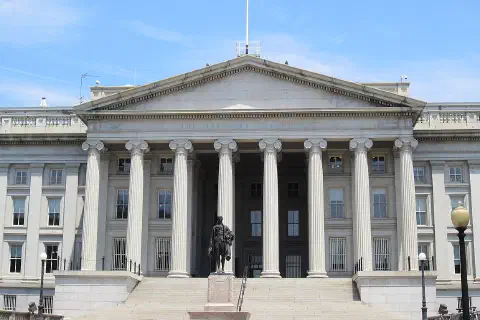
Gridlock helps bonds until the debt ceiling
Democrats won control of both the House and the Senate in Tuesday's midterm elections, CBS News projected, with a handful of races still being counted. Stock futures fell, artificial-intelligence shares dropped in Asia and the dollar slipped, Reuters reported. Treasury yields dipped. That last move is the one worth thinking about, because a government that cannot agree with itself has become, for now, the closest thing America has to a limit on its deficit.
It is a limit with a date attached. Tai Hui of J.P. Morgan Asset Management put the good news and the bad news in one breath: a divided government means deficits are "likely to be much more controlled", and "you do have a debt ceiling some time next year". The ceiling may arrive sooner than that suggests, and it is the first real test of what the bond market thinks it has just been given.
What the election removed
Most large changes to American spending and tax now go through budget reconciliation, a procedure that needs only a simple majority in the Senate. That is how the tax and spending law of 2025 passed. It works only when one party holds both chambers and the White House. From January that will no longer be true, so the route to another party-line tax cut closes. As CNBC noted before the vote, bipartisanship would be required for anything that moves.
For a bond investor this matters more than the headlines about investigations and impeachment. The 30-year Treasury yielded 5.28 per cent on Monday, according to the Treasury, a price that already includes compensation for holding American debt through decades of heavy issuance. If new deficit-financed laws become harder to pass, some of that compensation looks less necessary. Charu Chanana of Saxo read the early moves the same way: markets were pricing in less fiscal stimulus, which helps explain a softer dollar and weaker shares.
The limits of the argument should be stated plainly. Gridlock stops new laws. It does not cut the deficit already written into existing ones. Democrats may also want to reverse the 2025 law's health-care cuts, which would add to spending, though President Trump can veto them. The fall in yields so far is a small move on one night of thin trading, and Tuesday's ten-year yield of 4.95 per cent was still close to levels last seen in 2007. Some of the equity weakness, as Mr Hui and others noted, has more to do with a month-old slide in AI shares than with the vote.

The arithmetic of the ceiling
The statutory debt limit is $41.1trn. Treasury data show total public debt outstanding of $40.50trn on November 2, which leaves about $600bn of room. A small part of that debt does not count against the limit, so the true margin is slightly bigger. Even so, the same series stood at $39.74trn on August 3. Debt has therefore risen by about $760bn in three months, or roughly $250bn a month.
A straight line from those numbers reaches the limit in about two and a half months, which is around the end of January. That is a crude estimate: autumn borrowing is often heavy and the pace need not hold. The Bipartisan Policy Center, which models this properly, expects the limit to be hit between late winter and mid-summer of 2027. The Treasury's extraordinary measures would then buy time, six months or more on the centre's estimate, before the government ran out of cash. Default is not a near-term risk. A fight is.
That fight now has a different shape. CNBC's analysis made the point that the party outside the White House tends to use must-pass bills to extract concessions. Each side will hold a veto over the other for the first time in this presidency. In 2011 a similar stand-off ended with S&P stripping America of its AAA rating, and when Fitch did the same in 2023 it cited repeated debt-limit standoffs among its reasons.
Eight weeks of Republican control
There is one way round this, and the calendar sets it. Republicans keep both chambers until the new Congress sits in January. John Thune, the Senate majority leader, had indicated the debt limit could be taken up in the lame-duck session after the election, according to the National Taxpayers Union. A party-line increase before January would remove the fight from the new Congress altogether, though it would also remove the Democrats' best source of leverage, so it would not pass quietly.
The test for bonds is therefore fairly simple. If the ceiling is raised in the lame duck, the gridlock trade is cleaner: fewer new deficits and no cliff. If it passes into 2027 unresolved, the same gridlock that lowered yields on Tuesday night becomes the thing that can raise them, because investors would be asked to lend at 30 years to a government arguing over whether to pay. Tuesday's vote made a large deficit harder to enlarge. It did not make it any easier to finance.
Write to Arnav Goel at contact@thelombardreview.com
The Sunday Edition, in your inbox
India's economy, markets and money every Sunday, plus our analysis twice a week. Free.
Unsubscribe any time. See our Privacy Notice.