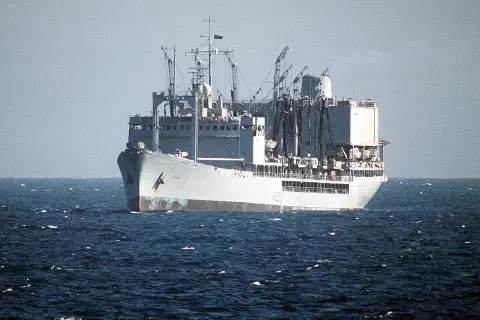
Iran closes the strait again

Iran's navy closed the Strait of Hormuz completely again on 12 June, blaming unprovoked provocations at sea, and the Gulf truce was over. Front-month Brent jumped back to $95.40. American energy data added to the gloom, showing that total domestic petroleum stocks, including the Strategic Petroleum Reserve, have fallen by 79 million barrels.
The curve snaps back
The renewed blockade jolted the whole oil futures curve at once, from prompt contracts out to the far months. Backwardation widened to extreme levels as physical traders rushed to lock in prompt barrels. Hopes of a clean diplomatic settlement were gone within hours, and algorithmic funds had to scramble to cover their short positions.
The order of the moves is instructive. Prompt contracts rose most, because they price oil that must be delivered while the strait is shut, and the later months rose less, because they still carry some probability of a settlement. The gap between the two is the market's running estimate of how long the closure will last and how scarce barrels will be in the meantime. A curve that steepens this sharply is pricing weeks of disruption, not days.
Why low stocks make spreads jumpy
The theory of storage, worked out by economists such as Holbrook Working and Nicholas Kaldor in the middle of the last century, explains why the spreads move so violently. When inventories are ample, a supply shock can be absorbed by drawing on tanks, and the price of prompt oil barely rises relative to later oil. When inventories are thin, each additional barrel of lost supply has to be rationed by price, and the premium for immediate delivery climbs steeply. The relationship is not linear: it is flat when stocks are high and almost vertical when they are low.
That is why the 79 million barrel draw matters more than its size suggests. On its own the figure is equivalent to only about four days of American petroleum consumption. What counts is where the draw leaves stocks on the curve. Having spent part of its cushion on the first closure, the market is now further up the steep part of that curve, so the same loss of supply produces a larger price response than it did in the spring.
Reserves already spent
Policymakers have a bigger worry, which is how little is left in reserve. America drew down 79 million barrels over the spring to hold down fuel prices, and now faces a closed strait with its emergency stocks much reduced. The Strategic Petroleum Reserve was created in 1975, after the Arab oil embargo, precisely to provide a buffer against this kind of interruption, and it was already depleted by the large sales ordered after Russia invaded Ukraine in 2022.
The reserve's physical limits matter as much as its level. Oil is stored in salt caverns on the Gulf Coast and can be pumped out only at a set maximum rate, which falls as the caverns empty. A reserve that has already been drawn hard can deliver less oil per day as well as less oil in total, so the government's ability to cap prices during a second shock is weaker on both counts.
Other governments hold buffers of their own. Members of the International Energy Agency are obliged to keep emergency stocks equal to at least 90 days of their net oil imports, and the agency can coordinate releases across countries, as it did in 1991, 2011 and twice in 2022. A coordinated release would help, but Japan, South Korea and the European members face the same arithmetic as Washington: every barrel sold now is a barrel unavailable if the closure drags on into the winter.
What 1991 suggests
The most useful precedent is the Gulf crisis of 1990 and 1991. After Iraq invaded Kuwait in August 1990, oil prices more than doubled within weeks. The first emergency sale from the American reserve was announced in January 1991, as the air war against Iraq began, and prices fell sharply once it was clear that Saudi output and allied control of the Gulf would keep oil flowing. The release worked because the reserve was large relative to the shortfall and because the military outcome removed the risk behind the price.
Neither condition holds now. The reserve is smaller relative to the potential loss of Gulf supply, and the second closure has shown that diplomatic progress can be reversed overnight. A release today would buy time rather than settle expectations.

The case against panic
There are reasons the price response may be more contained than in the spring. The first closure prompted refiners and governments to build contingency supply, including more crude routed through Saudi Arabia's East-West pipeline to the Red Sea and the United Arab Emirates' line to Fujairah, which bypass the strait. American shale producers have had several months of high prices to add rigs, and higher prices have already trimmed some demand.
Those offsets are real but slow. Shale output takes months to respond to new drilling, the bypass pipelines cannot carry all of the Gulf's exports, and demand for fuel in the short run falls only modestly even when prices rise sharply. In the weeks that matter for the curve, the price has to do most of the work.
The macroeconomic consequences follow from that. Higher fuel prices feed straight into headline inflation, and a second shock arriving before the first has faded raises the risk that businesses and workers start to expect persistently higher prices. The Federal Reserve, which has so far treated the oil shock as a temporary supply disturbance, will find that harder to argue if pump prices rise again through the summer.
What to watch
Three sets of data will show whether the shock is intensifying. The weekly inventory report from the Energy Information Administration will show how fast commercial stocks are falling now that the reserve can do less. The spread between the first two Brent contracts will show how tight physical markets are. The Commodity Futures Trading Commission's weekly positioning data will show whether speculators have rebuilt the length they were forced to abandon.
With 79 million barrels already spent, Washington has little left to release, so this second blockade is likely to push fuel prices up faster than the first. American drivers should expect pump prices to rise through the summer driving season, and the prompt Brent spread is likely to stay at extreme levels until ships are moving through the strait again.
Write to Arnav Goel at contact@thelombardreview.com
The Sunday Edition, in your inbox
India's economy, markets and money every Sunday, plus our analysis twice a week. Free.
Unsubscribe any time. See our Privacy Notice.