Japan spends trillions to defend one number

The Bank of Japan has been buying government bonds at a record pace, more than ¥5 trillion in a day, to defend its new yield ceiling, and it now holds more than half of the entire 10-year JGB market. It is one of the boldest interventions any central bank has attempted. After Haruhiko Kuroda's committee widened the 10-year yield band to ±0.50 per cent in December, global macro hedge funds piled in to test whether the BOJ would really hold the 0.50 per cent cap. The fight between official decree and market forces shows how close Yield Curve Control is to the end of its road.
The arithmetic of capping yields while inflation is high works against the BOJ. With core inflation at a four-decade high of 4 per cent, pinning the 10-year yield at 0.50 per cent leaves real government yields at minus 3.5 per cent, which gives investors every commercial reason to sell the bonds short.
Why December invited a test
The December decision was meant to relieve pressure, and it did the opposite. By widening the band while insisting policy had not tightened, the Bank showed that the cap could move, and a cap that has moved once can move again. Traders who had watched the yen slide to its weakest in three decades last autumn concluded that the Bank was already looking for an exit, and that betting against the new ceiling offered a limited loss and a large potential gain.
Those bets are placed mostly through JGB futures and by selling bonds the funds have borrowed. Every bond sold at the ceiling must be bought by someone, and at a yield that low, the only willing buyer is the Bank itself.
Nobody else is trading
To defend the cap, the BOJ has to buy every bond offered at the ceiling price. In doing so it has all but killed secondary trading. On several days not a single 10-year benchmark bond changed hands between private investors.
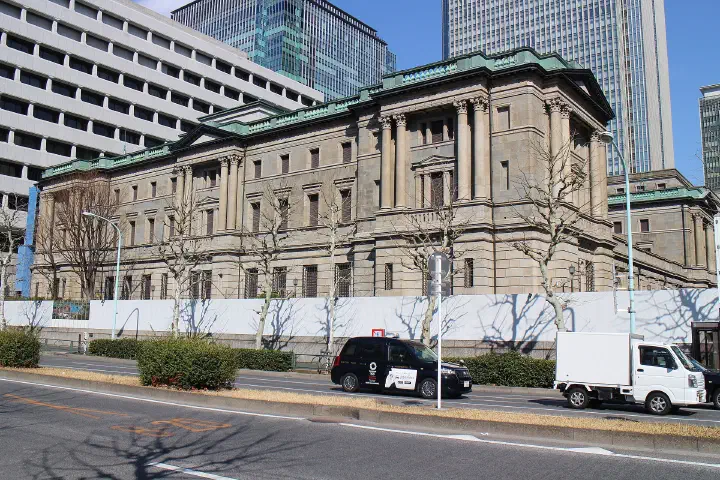
The Bank's main weapon is the fixed-rate purchase operation, a standing offer to buy unlimited amounts of chosen bonds at a set yield. It has run these operations every business day since last April, which means any investor who wants to sell at the cap has a guaranteed buyer. That guarantee removes the reason for anyone else to take the other side.
The Bank of Japan has become the market. The yield curve now has an odd kink, with 8-year and 9-year bonds yielding more than the pegged 10-year paper. And the huge volume of bank reserves created to pay for the purchases works against the BOJ's own currency, putting fresh downward pressure on the yen.
The kink has practical costs. Japanese companies and local governments price their borrowing off the government curve, and a curve with a dent at ten years gives them a distorted benchmark. Yen interest-rate swaps, which the Bank does not control, have risen well above the cap, so borrowers who hedge in the swap market already pay rates that the bond market is not allowed to show.
Price or quantity, not both
The pattern matches every failed currency peg in history. An authority can fix the price of an asset or the quantity it holds, but it cannot fix both at once.
The record of those pegs is not encouraging. Britain spent heavily defending sterling's place in the European exchange-rate mechanism before leaving it on Black Wednesday in September 1992. The Swiss National Bank defended a floor for the euro against the franc for more than three years and then scrapped it without warning in January 2015, sending the franc sharply higher within minutes. The closest parallel is more recent: the Reserve Bank of Australia abandoned its target for three-year bond yields in November 2021 after markets pushed yields far above it, and the disorderly exit damaged its credibility.
Unlimited yen, limited patience
The strongest counterargument is that the analogy with currency pegs is imperfect. A central bank defending its exchange rate eventually runs out of foreign reserves, whereas the Bank of Japan pays for bonds with yen it can create without limit. In a narrow sense it cannot be forced to give up.
The constraint lies elsewhere. Each purchase adds to the reserves that weaken the yen, raises the Bank's own exposure to losses if yields rise later, and further hollows out the market it claims to be repairing. A central bank can keep a cap in place indefinitely only if it is willing to own almost the whole market and accept a weaker currency and higher imported inflation as the price. Few governors would choose to start their term that way.
The losers from an eventual exit are easy to identify. Japanese regional banks and insurers holding long-dated bonds would take mark-to-market losses, and the Bank's own balance sheet would show paper losses on its enormous holdings. The winners would be domestic savers, who would earn a positive return at home for the first time in years, and the yen.
Decisions to watch
The Bank's policy meeting this week is the first test, followed by the government's nomination of Kuroda's successor, expected in February. The spring wage negotiations, which conclude in March, will show whether inflation is feeding into pay, which is the condition the Bank has long said it needs before normalising policy.
With a change of leadership due in April, the current pace of buying cannot go on for long. The Bank of Japan may spend trillions of yen showing it can win the daily skirmishes, but with trading in its own bond market all but dead, it will probably have to abandon Yield Curve Control altogether, most likely once the new governor is in place after April.
Write to Arnav Goel at contact@thelombardreview.com
The Sunday Edition, in your inbox
India's economy, markets and money every Sunday, plus our analysis twice a week. Free.
Unsubscribe any time. See our Privacy Notice.