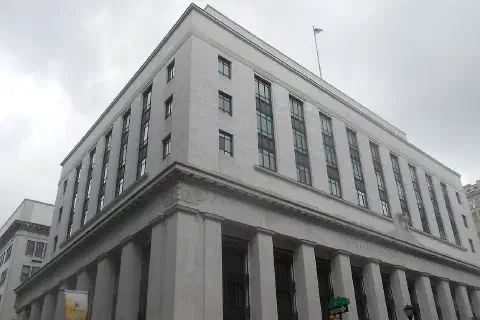
The Fed goes big

Jerome Powell opened the easing cycle with a half-point cut at the September FOMC meeting, taking the benchmark rate to 4.75–5.00 per cent. For two decades the Fed had started easing cycles with quarter-point moves unless markets were in outright panic. There was no panic this time.
The precedents for a half-point opener are not flattering. The Fed began with 50 basis points in January 2001, as the dotcom bust turned into recession, and again in September 2007, as the subprime crisis spread through money markets. In both cases the first cut was followed by many more. The committee is betting that this time the size of the move reflects caution rather than distress.
What the committee signalled
The cut came with a new set of projections that went further than the decision itself. The median official now expects another half-point of cuts before the end of this year and a full percentage point more next year. The committee raised its forecast for the jobless rate at the end of this year to 4.4 per cent, from 4.0 per cent in June, while lowering its inflation forecasts. That combination explains the size of the move better than any single data release.
The path matters as much as the step. Taken together, the median projections imply a policy rate below four per cent by the end of next year, which would still sit above the committee's estimate of the long-run neutral level. In other words, officials see themselves removing restraint gradually after an initial lurch, and they are not yet planning to stimulate the economy.
Bowman dissents
The vote was split. Michelle Bowman wanted a 25-basis-point step and became the first Fed governor to dissent since 2005. Powell was plain about his reasons: the committee wants to stop the labour market weakening any further. Moving hard at the start is meant to buy a soft landing while keeping the progress already made on inflation.
Mr Powell described the move as a recalibration rather than a response to an emergency, and rejected the idea that the Fed had fallen behind. The dissent matters because governors, unlike regional bank presidents, rarely break with the chair in public. It marks the start of an argument over pace that will run through the rest of the cycle.
Ms Bowman's objection rests on inflation that is not yet beaten. Core measures remain above the 2 per cent target, and she argued that a larger move could be read as a declaration of victory. The dot plot also showed a wider spread of views than the vote suggested, with a minority of officials pencilling in fewer cuts this year than the median.
Front-loading against gradualism
The economics of the choice are old. The standard case for gradualism, associated with William Brainard's work in the 1960s, holds that a central bank unsure of how its tools work should move in small steps and watch the results. The case for front-loading is that monetary policy acts with long lags, so a central bank that waits for clear evidence of a downturn will ease too late. With the real policy rate still well above most estimates of neutral, the Fed judged that the cost of waiting exceeded the cost of overdoing it.

The real rate is the crux. The Fed held its target range at 5.25-5.50 per cent from July 2023 until this week while inflation fell, so the inflation-adjusted cost of money kept rising. A half-point cut does little more than reverse some of that drift. Seen that way, the move is less a stimulus than a correction to a stance that had become tighter than anyone intended.
Other central banks chose differently. The European Central Bank and the Bank of England both opened their easing cycles this summer with quarter-point cuts, and the Bank of England held its rate at 5 per cent on Thursday, the day after the Fed moved. Their economies are weaker than America's, which makes the Fed's boldness more striking.
The ECB has since cut again, lowering its deposit rate to 3.5 per cent on 12 September, still in quarter-point steps. Its caution reflects services inflation that has proved stubborn in the euro area, and a governing council that remembers being accused of moving too late in 2021 and 2022. The Fed's willingness to move faster than its peers will tend to narrow the rate gap that has supported the dollar.
How markets took it
Investors took the decision as insurance rather than alarm. The S&P 500 closed at a record high the day after the meeting, while longer-dated Treasury yields rose, which suggests bond investors are not pricing an imminent recession. Borrowers with floating-rate debt get immediate relief as the prime rate falls to 8 per cent, while savers in money-market funds will see their yields drift down.
The rise in long yields is worth dwelling on. A central bank that cuts while long rates climb has steepened the yield curve, which helps banks that borrow short and lend long but does little for mortgage borrowers, whose rates follow the ten-year Treasury. If long yields keep rising, the Fed's cut will have eased conditions for companies on bank credit lines while leaving the housing market roughly where it was.
What would prove Powell wrong
The test is inflation. The September jobs report in early October and the consumer price figures that follow will show whether the labour market is stabilising and whether price pressures stay subdued. The next meeting, on 6 and 7 November, falls just after the presidential election. A rebound in core inflation before then would give Ms Bowman's position more support.
A strong jobs report would be almost as awkward. If payrolls reaccelerate and unemployment falls back, critics will argue that the half-point was an overreaction to noisy data, and the committee would probably slow to quarter-point steps or pause. The projections leave room for that, but markets currently price a faster pace than the median dot, so any retreat would push short-dated yields up.
The pricing so far favours the chair. Powell has staked the Fed’s credibility on the bigger cut. If inflation stays tame over the next few months he will look shrewd; if it picks up, the committee will spend next year explaining why it moved 50 basis points at once.
Write to Arnav Goel at contact@thelombardreview.com
The Sunday Edition, in your inbox
India's economy, markets and money every Sunday, plus our analysis twice a week. Free.
Unsubscribe any time. See our Privacy Notice.