Why ships won't sail through Hormuz

The Pentagon paused its naval convoy escorts through the Persian Gulf on 4 May, an embarrassing halt to its plan to reopen the route to trade. Guided-missile destroyers were on hand, and tanker fleets still would not enter the Strait of Hormuz. The reason is money. London's war-risk insurance syndicates have priced the passage so high that no voyage adds up.
Five per cent a trip
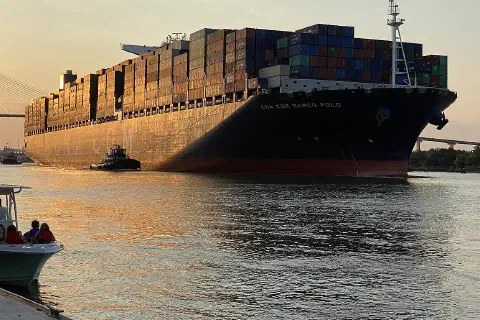
A merchant ship goes nowhere without hull and machinery cover and protection and indemnity (P&I) insurance. After recent drone strikes on civilian vessels, Lloyd's of London underwriters and the mutual P&I clubs raised additional war-risk premia to five per cent of a ship's insured hull value for each single transit. On a Very Large Crude Carrier (VLCC) worth $120 million, that comes to a $6 million surcharge for a voyage lasting twenty-four hours.
A VLCC carries about 2 million barrels, so the surcharge works out at roughly $3 a barrel on a full cargo. That comes on top of the ordinary freight rate, cargo insurance and the cost of a ship sitting idle if it is held up. The strait normally carries around a fifth of the world's oil consumption, so the cost of the premium applies to a very large share of seaborne crude.
How war cover is priced
Standard hull policies exclude war, so owners buy war cover separately, and underwriters keep the right to cancel it at short notice and requote once a region turns dangerous. The London market's Joint War Committee publishes a list of high-risk areas, and a ship entering one must notify its insurers and pay whatever additional premium they set for that voyage. The price is therefore charged per transit rather than per year, which is why it jumps after each attack. The P&I clubs, which cover most of the world's ocean-going tonnage for liabilities such as pollution and crew injury, treat war as a separate risk too.
The premium is only the visible part of the underwriters' caution. War-risk syndicates lay off much of their exposure with reinsurers, and when reinsurers cut the capacity they will offer for a region, the primary market can quote only so many hulls at any price. A quote of five per cent is partly a signal that the market would rather not write the risk at all.
Who pays the premium
Standard charter contracts decide where the bill lands. The war-risk clauses used in most tanker charters let an owner refuse to enter a zone it judges dangerous, and oblige the charterer to reimburse any additional premium if the ship does go. The cost therefore passes to the oil trader or refiner that hired the vessel, and from there into the delivered price of crude. An owner who declines is within its rights, which is why a navy cannot order the tankers in.
Destroyers do not write policies
A warship can shoot down a missile. It cannot compensate an owner for the total loss of a hull or pay for an oil spill. Freight rates cannot carry a $6 million insurance charge on a single transit, so owners are keeping their tankers at anchor outside the Gulf of Oman.
The last time America escorted tankers through the Gulf offers little comfort. In 1987, during the Iran-Iraq war, the US Navy reflagged Kuwaiti tankers and escorted them under Operation Earnest Will, and the Bridgeton, a tanker on the very first convoy, struck a mine. Reflagging put those ships under American protection and American law, a stronger guarantee than escorts alone. The Red Sea is a more recent lesson: after Houthi attacks began in late 2023, a US-led naval operation failed to persuade most big container lines to return, and they kept sailing round the Cape of Good Hope.

The difference between the two episodes is instructive. During the tanker war of the 1980s, traffic kept moving despite repeated attacks, because premiums rose without making voyages uneconomic and Gulf producers were desperate to keep selling. In the Red Sea, container lines had a longer but workable alternative round Africa. Tankers loading inside the Gulf have no such detour, so the choice is between paying the premium and not sailing at all.
Crews matter as well. Under the industry's collective agreements, seafarers can refuse to sail into areas designated as warlike operations zones and must be paid a bonus if they go. An owner with a willing insurer can still find itself short of a willing crew.
Who gains from the standoff
Owners with tankers already outside the Gulf can charge more on every other route, since ships idling at anchor shrink the effective fleet. Gulf producers with pipelines that bypass the strait, Saudi Arabia's line to the Red Sea port of Yanbu and the United Arab Emirates' line to Fujairah, can keep some exports moving, though neither was built to replace the strait. Asian refiners, which buy most of the crude that normally passes through Hormuz, bear the worst of it.
The strain carries into currency markets. Big oil importers such as Japan, South Korea and India must pay more dollars for each barrel, which weighs on their currencies just as dearer fuel lifts their inflation. Their central banks then face the familiar squeeze of defending the exchange rate or protecting growth, and neither choice is comfortable while the strait stays shut.
What brings premia down
The case against the column is that premia reflect fear as much as losses, and can fall as quickly as they rose if a few weeks pass without an attack. Governments also have tools: America's Maritime Administration has statutory power to write war-risk cover when the commercial market will not, and finance ministries can reinsure the top layer of losses. Either would do more for transits than another destroyer. The number to watch is the premium quoted in London, not the count of warships in the Gulf. Until underwriters bring war-risk premia down, tankers will stay out of Hormuz whatever the navy offers, and the escorts will have little to escort.
Write to Arnav Goel at contact@thelombardreview.com
The Sunday Edition, in your inbox
India's economy, markets and money every Sunday, plus our analysis twice a week. Free.
Unsubscribe any time. See our Privacy Notice.